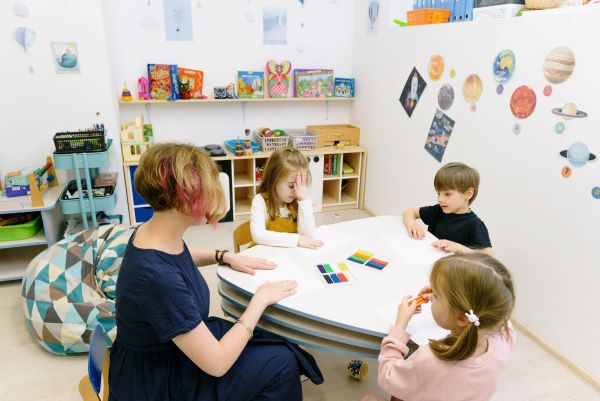
Occupational Therapy
What is Occupational Therapy
Occupational therapy is a specialized science in the field of health, which improves skills of
people with dysfunction in the areas of development.
These areas concern:
- Self-service of the individual and their independence in activities of daily life such as feeding,
clothing-shoes safety, movement, personal hygiene.
- The productivity of the individual where their ability in the field of work is assessed. For the
child, "work" is the game and their learning development.
- The person's mobility, where their ability to coordinate parts of the body (upper and lower
limbs) with fine or gross mobility is mainly evaluated.
- The person's sensory skills where their ability to perceive their body (somatocognition) and how
they perceives the body's relationship with the environment (kinaesthesia) is assessed.
Visual and auditory perception (the individual's perception of visual and auditory stimuli) and
stereocognition (determining the size, texture and shape of an object).
- The Cognitive skills of the person where their ability to perceive, memory, attention -
concentration, thinking, communication, judgment and other mental abilities that play a primary role
in the process of processing cognitive information are assessed.
- The Behavior and Socialization of the individual so that they adapt (behaviorally) to a given
situation. To have self-awareness, to participate in dyadic and group relationships (interaction of
a person with familiar and strangers). Also to follow rules of social behavior.
Occupational Therapy Intervention
The occupational therapist in accordance with these areas evaluates the functionality of the
individual and trains the skills they must have in order to cope satisfactorily with the demands of
their daily life.
Pediatric Occupational Therapy and Intervention
Pediatric occupational therapy deals with disorders that hinder the normal development of children.
There, the occupational therapist, using play as the main medium, deals with training the child's skills
related to cognitive and learning difficulties, movement difficulties and behavioral problems.
In which areas does Occupational Therapy intervene?
- Cognitive-Perceptual Domain
- Concentration-attention, organization, spatio-temporal orientation, understanding, etc.
- Rough mobility
- Coordination of upper and lower limbs, balance, organization, strengthening, relaxation
- Fine mobility
- Pencil grip, graphomotor coordination, visuomotor and bilateral coordination
- Social skills domain
- Eye contact, social responsiveness, adaptability and rule following
- Self-service area
- Daily life skills (clothing-footwear, personal hygiene, toilet, feeding)
- Contact
- Verbal and non-verbal communication skills
- Sensory domain
- Sensory skills training where they focus on three basic senses (tactile, vestibular,
proprioceptive).
What diseases does Pediatric Occupational Therapy address?
- Autism spectrum disorders
- Brain paralysis
- Mental retardation
- Syndromes (Down, Attention Deficit)
- Learning difficulties
- Psychosocial retardation
- Maladaptive behavior